
2006 Marine of the Year
honorable

Sgt. Jason Delgado
Sgt. Jason Delgado's boss said his performance is above and beyond. Besides his normal administrative duties, Delgado serves as a casualty-assistance clerk, a position requiring many hours of work behind the scenes.
In 2005, he spent hundreds of hours standing guard over the caskets of fallen Marines. He also participates in color guards and funeral details throughout Colorado.
Delgado reaches out to the families of fallen Marines by spending time talking with them and helping them through their grief.
"He has never shied away from creating a bond with the family, letting them know Marines care for Marines," a co-worker said.
2006 Marine of the Year
honorable
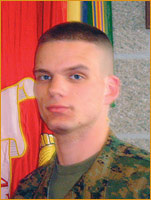
Sgt. Jonathan Coffey
For mothers in Washington state whose sons are killed in Iraq, Sgt. Jonathan Coffey is there long after the last note of "Taps" sounds.
Coffey, a supply admin clerk at 4th Landing Support Battalion in Tacoma, Wash., has made it his "mission in life" to keep the memories of their sons alive, he said. Off duty, he participates in color guards and funeral details.
Coffey even bought a set of dress blues for a lance corporal who was injured in Iraq and helped get him recognized at a Seattle Mariners game.
Coffey also works with Michael Reagan, an artist who draws portraits of service members killed in the war on terrorism and donates them to the families. The Marine sometimes wishes he had more time to himself, but "taking care of others means more" than days off, he said.
2006 Marine of the Year
winner
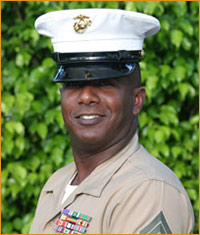
Staff Sergeant Kent Padmore
Emigrated to the U.S. from Trinidad and Tobago at age 22 in 1990. Enlisted in the Marine Corps Reserve in 1994.
HIALEAH, Fla. - The Purple Heart on Kent Padmore's chest isn't for the shrapnel from an enemy rocket-propelled grenade that tore a cheek-to-cheek gash across his face. That wound was never documented; Padmore fixed it himself with a liquid suture in the rearview mirror of his Humvee.
Padmore, a Marine reservist, works in civilian life as a City of Miami Fire-Rescue Department emergency medical technician, so he knew what to do. He patched himself up because he didn't want to steal precious time from the corpsmen in his unit, who were busy treating more seriously wounded Marines. Instead, the Purple Heart he wears is for the second-degree burns on his hands and arms he suffered while dragging 10 Marines out of the burning wreckage of a 7-ton truck on June 23, 2005.
An anti-tank missileman by military specialty, Padmore was leading the security force at a civil-military operations center near Fallujah, Iraq, when he and his Marines were assigned to escort a two-vehicle convoy to Camp Fallujah, 20 minutes away.
The lead 7-ton truck carried a special detail of female Marines trained to search Iraqi women. Padmore and most of his Marines were riding in the back of the trace vehicle when a suicide car bomber crashed into the front of the convoy.
Padmore's driver slammed the brakes and the security detail in the back of the truck tumbled forward as debris from the lead vehicle flew over them.
Padmore, then a sergeant, said he knew it was a mass-casualty situation that could potentially overwhelm the one or two corpsmen on hand. As enemy small-arms fire began barking from rooftops lining the road, he leapt from his vehicle and rushed across 200 yards of open terrain to reach the wounded.
When he made it to the burning vehicle, rounds from its mounted .50-caliber machine gun were cooking off in all directions. Padmore dragged six Marines to cover, left his helmet and weapon with them, and returned to the vehicle to rescue four more people.
Disregarding the burns on both his hands, the native of Port of Spain, Trinidad and Tobago, went into EMT mode, triaging casualties and administering first aid that was later credited with saving the life and leg of one of the wounded Marines. For that, he was awarded a Navy and Marine Corps Commendation Medal with "V."
Padmore has been an EMT in Miami for eight years. For the last two, he has also worked as a flight medic for Baptist Hospital, a position that required six years' experience "on the street as a paramedic," he said. "I wanted to be able to continue the care of the people I transferred to the helicopter. I wanted to do more," he said.
Around Padmore's fire station, his co-workers know he's too humble to talk about his bravery and compassion, so they do most of the talking for him. Fire Chief Dan Meadows said he wasn't surprised to hear June 8 that the local Navy League was naming Padmore the Broward County, Fla., Marine Reservist of the Year - at a ceremony Padmore had never mentioned. "He serves his community every day … with more heart than most people who were born here," said fellow paramedic Jose Almeida. "But if we didn't say this stuff, nobody would know."
Padmore's co-workers talk about how he still writes to an 8-year-old girl named Farah whom he befriended in Iraq. Padmore said he taught her math when she'd visit him on guard duty, and that when he's with his 5-year-old son, Kemario, he imagines Farah playing alongside him.
Junior Marines idolize Padmore, according to Maj. Chris Guarnieri, inspector-instructor at Padmore's unit.
He's "a very persuasive leader," Guarnieri said. "He doesn't yell or use threats. He has a lot of credibility with the Marines, and they listen to him."
2006 Soldier of the Year
notable
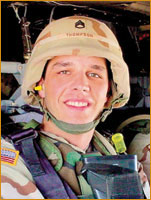
Sgt. 1st Class Mark Thompson
A diabetic and spokesman for the American Diabetes Association, Sgt. 1st Class Mark Thompson drafted multiple backup plans to convince his commanders he could serve in Iraq, where conditions are unpredictable and insulin is not readily available.
2006 Soldier of the Year
notable
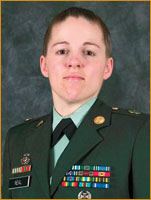
Sgt. 1st Class Marlena Neal
Despite losing her home to Hurricane Wilma, Sgt. 1st Class Marlena Neal helped the area recover and kept operations running. She also worked to increase the command compliance rate for the PT test and volunteered to help run a Junior ROTC competition.
2006 Soldier of the Year
notable
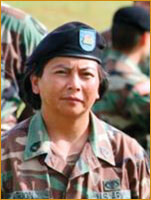
Sgt. 1st Class Madeline Aguon
Sgt. 1st Class Madeline Aguon, a combat medic, volunteered in 2004 for duty in Iraq, where she was injured, then later deployed to the Horn of Africa. She also translated a patriotic song into the Chamorro language of Guam and sings it at military ceremonies.
2006 Soldier of the Year
honorable
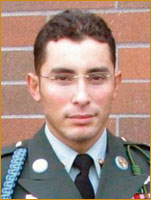
Sergeant Moises Martinez
Sgt. Moises Martinez doesn't expect anything in return for saving a stranger's life.
Martinez was in the Tacoma Mall in Washington state on Nov. 20, 2005, when a gunman opened fire. The Iraq veteran shielded two young children and whisked them and another child to safety, then returned to the mall and found a shopper who had been shot five times.
Even though the shooter was in the store next door, Martinez treated the man's wounds and kept him from going into shock.
He stayed with the man for about 90 minutes and made a litter from a folding table before police and paramedics arrived.
"The only thing you want to do is give the guy some kind of hope and reassure him that everything's going to be OK," Martinez said.
2006 Soldier of the Year
honorable
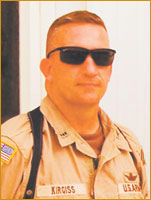
Chief Warrant Officer 4 Randy Kirgiss
No matter where he's deployed, Chief Warrant Officer 4 Randy Kirgiss has always tried to do something for children.
When Kirgiss, a UH-60 Black Hawk pilot, deployed to Iraq in early 2005, he picked up on a friend's idea and initiated Operation Teddy Drop.
By the end of their tour, Kirgiss and his fellow aviators had dropped more than 22,300 stuffed animals from their aircraft to Iraqi children. They also fashioned parachutes for each toy so the gifts would float to the ground.
Operation Teddy Drop was a morale booster, Kirgiss said, and it was nice to see the children's reaction upon receiving the stuffed toys.
During their yearlong tour, Kirgiss and his fellow soldiers flew 20,000 combat hours with no recordable accidents.
2006 Soldier of the Year
winner
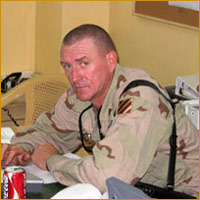
Master Sgt. Richard Burnette
Single father of three: Chelsea, 16; Adam, 13, and Erica, 12. Burnette has a Bronze Star, Purple Heart, four Meritorious Service Medals, eight Army Commendation Medals and five Army Achievement Medals.
FORT STEWART, Ga. - The soldiers who work with Master Sgt. Richard Burnette say he's one of the toughest guys they've ever known. And he's the kind of leader they aspire to be.
"My first impression was, 'Oh my God, I hope he's not here that long,'" said Sgt. 1st Class Michael Thomas, recalling when both soldiers arrived at 2nd Brigade, 3rd Infantry Division Brigade Troops Battalion two years ago. But those first impressions faded fast.
Thomas shakes his head now and remembers the dreadful day last year when he was sitting in the battalion's tactical operations center in Baghdad. It was May 1 and the unit had just suffered its first major attack with casualties. One of those was Burnette. "I was on the radio. We just sat there in surprise in the TOC waiting to hear," Thomas said.
He remembers thinking: "Who was going to pull us together now that he's gone?" Burnette, now 43, survived but had been severely wounded, his thumbs blown off by a suicide driver who exploded his cargo 10 feet away as Burnette stood outside his Humvee with a group of four children.
All of the children were killed, and Burnette was knocked down, sprayed with shrapnel, suffering severe wounds in his left arm.
He spent several painful months in recovery at Walter Reed Army Medical Center in Washington, where he became an "older brother" figure to other wounded soldiers who needed help and guidance during their stays at the hospital.
Burnette wanted to return to Baghdad but never could. It was his first combat deployment, one he could have easily forgone by retiring after a stint as a first sergeant in basic training at Fort Jackson, S.C.
"I knew I was going to Iraq, and there was no way I could walk away just to get out of the battlefield. My conscience wouldn't let me do that," said Burnette, a single father of three since a 1996 divorce.
He lives today with a chronic ringing in his left ear and throbbing pain in his hands. When he walks, he said, "it feels there's rocks in my boots. Barefoot, it's almost unbearable."
Occasionally, his soldiers say, Burnette slips back into drill sergeant mode. He's known for never asking anything of a soldier he wouldn't ask of himself.
"What stood out in Iraq was, as a master sergeant, you don't have to do [physical training], but he was out there with us every day," Spc. Toulia Yang recalled. Burnette earned the respect of his senior leaders, especially battalion commander Lt. Col. Jamie Gayton, who made him battalion operations officer, a demanding slot usually filled by a field-grade officer.
Gayton knew Burnette had the skills required to run the S-3 shop. Plus, he needed all of his junior and field-grade officers for the brigade's monumental reconstruction mission in eastern Baghdad.
"At the Joint Readiness Training Center, it became obvious he was the one," said Gayton, who nominated Burnette for Army Times Soldier of the Year.
Burnette worked 18-hour days while watching out for the well-being of his soldiers. "When you task out two, three, four things and have to move on to other things, he's the guy who would come back and brief me at 1800, 2000 or 2100," Gayton said.
Burnette acknowledges he's no softie - except with his kids - and he said he would never show his soldiers his sentimental side. But he is quite sentimental about soldiers. "The biggest thing to me is they [serve] voluntarily, even though they could be [sent to] the battlefield again," Burnette said. "Even if they stay or get out, I have to respect them because I was there at one point. I was that private."