
2014 Marine of the Year
winner
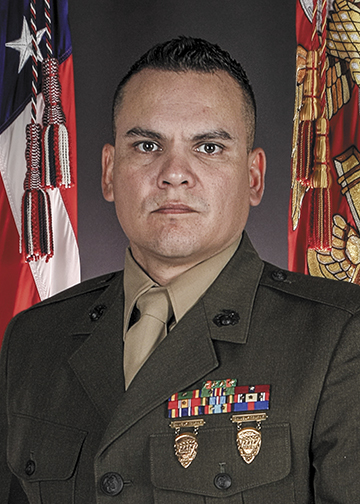
Master Sgt. Orlando Reyes
Whether deployed or in garrison, Master Sgt. Orlando Reyes works ceaselessly to protect his fellow Marines. After three combat deployments to Iraq, he returned home and picked up a tenacious fight against an enemy as deadly as an IED – suicide.
Reyes is now the operations chief for Headquarters and Support Battalion, Marine Corps Installations – East at Camp Lejeune, North Carolina. In addition to his primary duties, Reyes heads the command’s Never Leave a Marine Behind suicide prevention program.
He was nominated for Marine Corps Times Marine of the Year as much for the care he shows towards Marines in garrison as for his service in the war zone.
Reyes’ list of accomplishments is long. A few highlights include: leading Marine rifle and pistol teams to victory in Okinawa; being named recruiter of the year in 2003; leading the charge to raise $25,000 for a 2008 birthday ball that drove ticket prices down to just $10 each -- including open bar -- and earning a Navy and Marine Corps Achievement Medal with four stars for his steadfast dedication.
“Master Sergeant Reyes is passionate about being a Marine, enjoys mentoring junior Marines, provides sound guidance to peers and offers solid advice to seniors. In short, he exemplifies the core values of military service.”Maj. Shawn D. Miller
He has left his greatest mark through his unyielding efforts as the top suicide prevention trainer on the East Coast. Reyes has certified at least 60 master trainers and 75 trainers since arriving at his current assignment in 2011 – all of whom work throughout the Corps to turn around the devastating suicide epidemic.
Driving him is his own experience with attempted suicide, an anecdote he uses to inspire students.
“A Marine was getting ready to deploy; he had marital problems and reached the breaking point. He decided to end the pain by swallowing a bottle of pills.
“That Marine stands here today,” he tells classes to convey the gravity of their mission.
As a result of Reyes’ work, interventions began occurring in cases that previously would have fallen through the cracks. Still, he remained unsatisfied and worked to create H&S Battalion’s own master trainer program.
Beyond suicide prevention, he takes great interest in the personal lives of his Marines, saying that although he is a senior leader, he wants his Marines to work for him “because they want to, not just because they have to.”
Just two courses shy of a bachelor’s degree in organizational management, Reyes says he wants his Marines to get ahead by taking on responsibilities commensurate with a rank above them, using every resource available for career and academic advancement.
The son and brother of soldiers, he joined the Corps in 1994 saying he didn’t want to join another service and wonder if he could have hacked it as a Marine.
2014 Sailor of the Year
winner
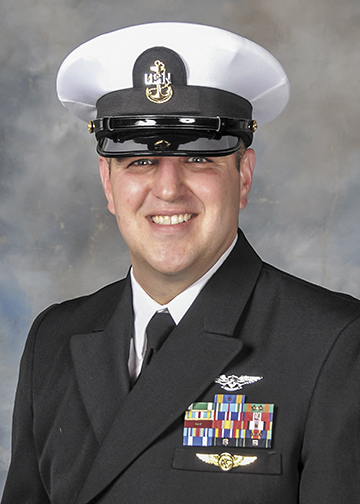
CTRC Jeremy Crandall
Chief Cryptologic Technician (Collection) Jeremy Crandall is described by superiors and subordinates as a humble leader driven by a desire to see sailors develop and succeed.
Crandall’s career as a cryptologic technician is storied. He had fewer than two years in uniform when, on April 1, 2001, he was one of 24 crew members detained by China after a collision between their EP-3E ARIES II signals intelligence aircraft and a Chinese J-8II interceptor fighter forced an emergency landing. In the long 11 days that followed, he witnessed the "strong and selfless leadership" of a senior enlisted crew member who helped get the team through its harrowing ordeal. This example had a lasting impression on Crandall, who cites this as the defining model of his own career.
Crandall has spent much of the past 15 years encouraging and enabling at-risk sailors who face dire circumstances of their own. Most recently, the chief created BALLAST, a wide-ranging program centered on 342 hours of classroom instruction covering everything from financial management and drug/alcohol awareness to naval history and professional appearance. The program also features 18 hours of community service. Named after the ballast used to keep a ship upright and afloat, the program is nearing completion of its first year. Though it was originally designed to correct and direct at-risk sailors, the program has gained popularity among enlisted leaders and now has a waiting list of volunteers who look to grow personally and professionally.
“Chief Crandall is a strong example of what it means to be a Navy chief. He has the attention of his subordinates, the respect of his fellow chiefs, the support of the ship’s officers and the trust of his commander.”Capt. Karl Thomas, Abraham Lincoln’s commanding officer
There is little need for a cryptologic technician while a nuclear-powered carrier goes through the three-year Refueling and Complex Overhaul. Instead of coasting through this tour, Crandall stepped up to take charge of the ship's security forces. In that role, he leads one of the ship’s largest divisions – 128 sailors representing 22 different ratings. The division has achieved a 70 percent advancement rate and 90 percent retention rate, and 36 sailors have earned individual warfare qualifications.
The chief’s selfless service does not end when he departs the carrier. The Civil War buff has more than four dozen volunteer hours as a historical guide in Lee Hall Mansion in Newport News, Virginia. Crandall also mentors dozens of youths at his local church, and does so while maintaining a 3.90 grade point average in pursuit of his bachelor’s degree in history from Southern New Hampshire University, where he was recently inducted into Alpha Sigma Lambda, a national honor society that recognizes high academic achievement.
Crandall's warfare qualifications include the Enlisted Information Dominance Warfare Specialist, Enlisted Surface Warfare Specialist, Enlisted Aviation Warfare Specialist and Naval Aircrewman designations, and his personal awards include the Air Medal, Navy Commendation Medals and the Navy Achievement Medal.
2014 Airman of the Year
winner
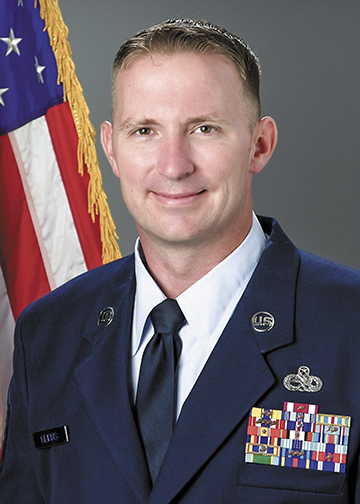
Master Sgt. David Keirns
Master Sgt. David Keirns saw the geese drifting above the flight line just after the fully-loaded C-5 took off from Naval Station Rota, Spain. Then came the unmistakable sound of a bird strike – like something stuck in a lawn mower.
As production superintendent, Keirns was responsible for coordinating emergency response as the massive C-5 made an emergency landing, its brakes locked, engine spitting and landing gear in flames.
“It could have been catastrophic,” said Chief Master Sgt. Timothy DeBeaux, squadron superintendent. “I wouldn’t want to think about if we had a less capable person in charge that night.”
The C-5 sustained more than $2 million in damage, but no one was injured.
It was April 19, 2013 – Keirns’ first night back on duty following a 365-day voluntary deployment to Afghanistan.
In Kabul, Keirns took on an astounding array of missions and duties. He served as an air adviser tasked with developing a technical school to train aircraft maintainers for the Afghan air force. A jet mechanic by trade, he ultimately trained 366 students, tripling the number of aircraft maintenance instructors in the Afghan air force. Keirns also saw to the construction of Mi-17 simulators using scrap parts – saving $7.9 million in training aid costs. And all the while, he was in charge of the Afghan interpreters.
While he could have held his war-zone contributions to those valuable efforts, he volunteered for duty outside the wire, leading 25 convoys and assisting with many others. He also volunteered for 22 flight overwatch missions, flying to 14 forward operating bases.
“Without a doubt, his work developing the next generation to ensure they, too, are the premiere fighting force is his greatest contribution.”Lt. Col. Christopher M. Cunniff, commander, 725th Air Mobility Squadron
As lead section chief for the 725th Air Mobility Squadron at Rota, Keirns leads four senior noncommissioned officers who manage 120 airmen supporting aircraft headed to and from Europe, Asia and Africa.
He is also one of four founding members of “Rota 25,” a program aimed at providing mentorship to new sailors, Marines and airmen. The “Rota 25” curriculum covers 10 Department of Defense climate programs and reinforces core values to enlisted members 25 and younger, a group often vulnerable to high-risk behavior. Since the program was developed in 2013, the more than 180 who have completed the program have stayed out of trouble.
Keirns’ role in “Rota 25” is a testament to what his superiors see as his greatest contribution: developing the next generation of Air Force leaders. Though December retention boards left Keirns facing almost certain involuntary retirement, he has not strayed from his dedication to helping fellow airmen and the Air Force succeed.
“Instead of going through the motions like everybody else and dealing with the what-ifs, he is calm and steadfast, remaining professional and still doing the job,” said Tech. Sgt. Eduardo Morales. “He said, ‘I have a job to do. The rest will take care of itself.’ It was about performing the mission. We all followed suit.”
2014 Coastguardsman of the Year
winner
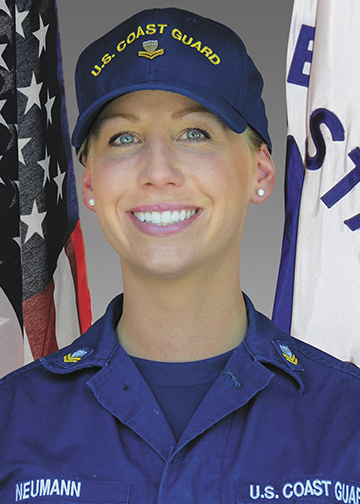
OS2 Lindsey Neumann
When the tour ship HMS Bounty started sinking off the coast of North Carolina in 2012, Operations Specialist 2nd Class Lindsey Neumann answered the distress call that launched 14 aircraft and two ships to safely rescue 14 members of the 16-man crew.
A year later, her watch team coordinated search-and rescue efforts for a sinking 149-foot passenger boat, saving the lives of the seven crew members and keeping the vessel from going under.
As a situation unit controller, Neumann is responsible for keeping track of Coast Guard assets in her sector’s 3,000 square miles of responsibility, assessing incidents and providing guidance to boats and aircraft on conditions.
All told, Neumann had the watch for more than 70 search-and-rescue or law enforcement missions in 2013, totaling 120 lives saved or assisted, as a situation unit controller. She also serves as Sector North Carolina’s unit health promotion coordinator and community service coordinator, positions traditionally done by those above her paygrade.
It’s her job to track her unit’s health and wellness, from weight management to injury prevention, and create programs and resources to address her shipmates’ concerns and promote health throughout the unit. As community service coordinator, she partners with local organizations to provide a Coast Guard presence at community events.
On and off watch, her superiors describe her as the embodiment of the Coast Guard’s core values of honor, respect and devotion to duty.
Throughout her four years with the Coast Guard, Neumann has made an impression on not only her unit but her community. When she’s not standing 24-hour watches, she volunteers in the Wilmington, North Carolina, community while working toward a master’s degree in management with American Military University.
“Petty Officer Neumann has distinguished herself as a servant leader. … [She] understands the importance of public support and takes every opportunity to represent the core values of this United States Coast Guard.”Capt. Sean Murtagh, Sector North Carolina commanding officer
Neumann, fresh out of “A” school, arrived at Sector North Carolina in 2011. Soon after settling in with her unit, she joined Leadership Wilmington, a 10-month program put on by the city’s chamber of commerce to teach community leadership skills. Since graduation, she has volunteered as an event coordinator with the chamber of commerce to complete two dozen projects with local organizations, including helping the Boys and Girls Club secure a funding grant and participating in a Habitat for Humanity build and Adopt-A-Highway clean-ups.
She led a team of more than 100 volunteers to beautify The Yahweh Center, a home for abused, neglected and at-risk children, including planting a vegetable garden. She also volunteers with the Big Buddy Program, spending eight hours a month mentoring a child in her community.
Neumann has been recognized as the Navy League’s 2013 Coast Guardsman of the year, as well as Sector North Carolina’s enlisted person of the year and District 5’s enlisted person of the year for 2013. Her awards and decorations include the Defense Meritorious Service Medal, the Military Outstanding Volunteer Service Medal and the Rifle Marksmanship Ribbon.
2014 Soldier of the Year
winner
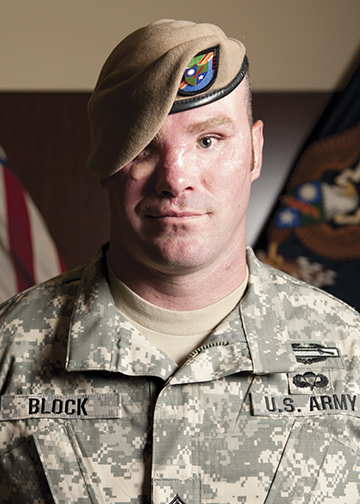
Sgt. Thomas Block
Sgt. Thomas Block and fellow Rangers from 3rd Battalion, 75th Ranger Regiment were patrolling in southern Afghanistan, on a mission to root out insurgents planning suicide bombing attacks. They entered a compound and saw a man and woman sitting in the courtyard.
The man was dressed in a T-shirt and sweatpants, while a woman – or possibly a man in a woman’s disguise – wore a burka and was suspiciously wrapped in a wool blanket.
Block, our 2014 Soldier of the Year, ordered the man to walk toward him with hands up.
As the man approached, Block grabbed him, and that’s when the woman jumped up and detonated the bomb strapped to her body. Block instantly used the male insurgent as a shield, but still was thrown 35 feet into a minefield, severely wounded. Four other soldiers died on that mission, and nearly two dozen others were wounded.
That was less than 10 months ago. Yet Block has battled back from his wounds, learning to walk again and enduring six surgeries, with at least four more to go. Doctors rebuilt his ocular bone, his nose and his cheekbone, which is now fitted with a titanium plate. They worked to preserve the vision in Block’s left and remaining eye, which now sees at 20/60.
Look at his right eye and you will it is a prosthetic bearing Captain America’s shield.
“He doesn’t like bullies,” says Block, “and neither do I.”
“He’s the guy that people hear his story and see an example of courage and bravery. Regardless of his age and rank, he sets a phenomenal example.”Capt. Peter Leszczynski, Sgt. Block’s company commander.
Block, 27, is an inspiration not only to his fellow Rangers, but throughout the Army. He’s spoken at leadership courses, mentored fellow wounded warriors and motivated soldiers to stay in the Army, despite the cutbacks and budget uncertainty. He’s even counseled the Oakland Raiders about resilience, perseverance and recovery.
Block is the kind of soldier Rangers want to follow, says his company commander.
“He shows up between operations and appointments just to talk to the guys and motivate them,” Block’s captain told Army Times. “When he walks in the door with his glass eye and his PTs, and he tells you that he’s just bench pressed 315 pounds, there’s not a guy in the room who’s not pumped up about it.”
Block would rather credit his fellow soldiers for their heroism – for saving his life on Oct. 5, 2013 - when they navigated a trap-laden compound to rescue him. And for continuing to motivate him today.
Despite his injuries, Block’s goal is to remain a Ranger, and also earn a college degree.
“This is hard, but it’s doable,” Block said. “I’m not going to let this be an excuse to hold me back. That’s going to be the example I’m going to set for everybody around me, and hopefully I can inspire, motivate in any way possible.”