
2010 Marine of the Year
honorable
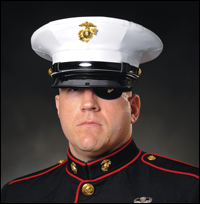
GySgt Edward Schrank
Schrank is medically retiring from the Marine Corps and considering a career in renewable energy.Shrank, 33, has twice been diagnosed with a rare cancer affecting his tear glands and brain. But despite his own battle for survival, Schrank works tirelessly to inspire Marines and help others who have cancer.
In recent years he has lost his left eye and parts of his skull as doctors have worked to treat him. While undergoing aggressive treatment, Schrank received the highest recorded dosages of standard and experimental radiation therapies.
“Gunny Schrank has used his adversity to inspire others,” wrote Navy Capt. Edward Martin, Schrank’s commanding officer, who nominated him for Marine of the Year. “While it would have been perfectly understandable for [him] to have focused on himself during his extensive cancer treatments, he chose to do just the opposite and focused on others.”
Schrank remained on active duty during his ordeal. He also writes two blogs aimed at supporting military and nonmilitary cancer survivors and ran in the “Men’s Health Urbanathlon” — an 11.76-mile race through Chicago, plus an obstacle course — while still recovering from the effects of chemotherapy. He used the race as an opportunity to raise about $22,000 to found C.STAR, a nonprofit cancer support organization.
“I have a fifty-fifty chance of making it through the next three years. This has been the experience of a lifetime, and I wouldn’t change a thing,” Schrank wrote in response to his nomination. “I have had the opportunity to affect people’s lives in both the Marine Corps as well as my community in a way not possible without this adversity.”
2010 Marine of the Year
winner
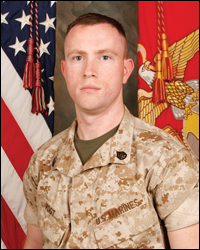
SSgt David Vogt, III
The 25-year-old from Lakeland, Fla., is married, and his first son, Joseph, was born in May.
CAMP PENDLETON, Calif. — Staff Sgt. David E. Vogt, a 25-year-old legal services chief, is an eternal optimist and a “living moral compass” for his fellow Marines, choosing to focus on the possibilities of what he and others can do to better the world around them.
He demonstrates this by giving up his free time to volunteer with local organizations and by inspiring Marines as well as disadvantaged teenagers and school kids.
“Never lose the possibilities of the day,” he said.
With his penchant for volunteering and mentoring others, Vogt has been selected as the 2010 Marine Corps Times Marine of the Year.
Just last year alone, Vogt spent nearly 500 hours volunteering with local and base groups.
He has volunteered at the Camp Pendleton base animal shelter. He’s read stories to school children and organized activities for elementary students at one of the base schools. He’s raised money in donations for a local homeless shelter and served meals for local senior citizens. Even after finishing his bachelor’s degree and chipping away toward a master’s degree, he continues to tutor Marines in college English and math.
In his six years in uniform, Vogt has been meritoriously promoted in rank four times. On April 2, he pinned on the first rocker of a staff sergeant.
Vogt is a consummate NCO and, according to superiors, a leader at heart. Tapped as a master trainer, he guided 1,350 Marines through the new NCO Suicide Prevention Program. He is also credited with directly helping to steer a troubled Marine away from possible suicide.
His command has taken note of all of Vogt’s efforts, this spring nominating the then-sergeant for Marine of the Year.
Vogt “is a living example of ‘duty, honor, country,’” wrote his supervisor, Lt. Col. Kent J. Keith. “He is truly dedicated to the Marine Corps and individual Marines. Although a perfect candidate for one of the Marine Corps commissioning programs … Vogt has elected to remain in the enlisted ranks for the sole purpose of being closer to Marines, allowing him the ‘hands-on’ ability to lead and mentor junior Marines.”
The command credits Vogt with inspiring other Marines to enroll for college classes and Marine Corps Institute courses.
“His honor is without question, and he is a living moral compass for all the officers and enlisted within the battalion,” Keith added.
Joining in the nomination was the battalion commander, Col. Philippe Rogers, who trusted Vogt enough to pick then-Sgt. Vogt to run the 1,700-member battalion as part of “NCOs Run the Battalion Week.”
“[Vogt] is the best NCO of Marines I have seen in over 23 years of service,” said Rogers, who noted he had ranked him the top sergeant among more than 150 sergeants in the battalion. “This is the consummate professional and Marine NCO — there [is] none better.”
It’s not uncommon for Vogt to dole out advice to younger Marines.
“A support net is not made with one rope,” he notes. “As a staff sergeant, I can use that to inspire younger Marines to do the same.”
“You get what you give, and you learn from the people you meet,” Vogt said. “You’ve got to get out of the box … even if it’s someone at the soup kitchen who has nothing other than a bowl. They can still teach you.”
Last summer, guided by his battalion commander, Vogt helped organize the unit’s NCO Association. He wrote its constitution, which, he said, reminds NCOs “to lead and inspire Marines to realize there is no limitation on what an NCO is capable of in their position and influence,” whether on junior Marines or superiors. The association was the first of its kind at Camp Pendleton — two others are now active.
The fledgling group elected him its first president. These days, Vogt serves as mentor to its more than 250 members. Last year, Vogt led the NCOs in organizing the annual Marine Corps Birthday Ball.
“We took it; we made it our own,” Vogt said. More than 1,000 people — officers and enlisted Marines plus families and friends — partied at the U.S. Grant Hotel in downtown San Diego. The event raised $20,000.
“It demonstrates there is no limit to what a sergeant, or a corporal, can do, especially when they team it up together and do it as a group,” Vogt said.
This past spring, he received the 2009 Defense Department National Image Meritorious Service Award, an honor given to the top enlisted Marine for community service work. Last year, he was named as Camp Pendleton’s Noncommissioned Officer of the Year, honoring his “superior volunteerism” and work with the Camp Pendleton Rotary Club.
After nearly three years working at Marine Corps Base Quantico, Va., Vogt spent about four months in Tampa, Fla., on special temporary assignment with Marine Corps Forces-Central Command. Then came orders to Camp Pendleton, and he ramped up his volunteer projects.
Vogt’s focus is now shifting as he prepares to deploy to Afghanistan as an individual augmentee, heading to the war zone with a I Marine Expeditionary Force legal team. It will be his first time in the combat zone.
2010 Soldier of the Year
honorable

Staff Sgt Eduardo Avila
Avila is from Woodside, N.Y.
Avila is well-known to his underprivileged neighbors in Queens, N.Y., where he resurrected a failing Boy Scout troop and recruited Scouts from around the neighborhood.
“Staff Sergeant. Avila is a mentor to underprivileged children on a daily basis,” said retired Sgt. 1st Class James Ortiz. “He is a scoutmaster and strong father figure to many, if not all, the children of his Scout troop. The values that Staff Sergeant Avila imparts to these children are the same Army values that Staff Sergeant Avila has learned and benefited from throughout his Army career.”
Avila has the Scout troop involved in community projects such as park restoration, food-pantry collections and other fundraising efforts. The troop offers children opportunities that some haven’t had before, such as camping and hiking outside the urban area. Avila and the Scouts worked with local community service organizations to collect and store camping gear for the troop.
“I was a Boy Scout as a youth in my neighborhood, and upon returning from a tour in Iraq, I found that there was no longer a scouting program,” Avila said. “I wanted to play a role in molding our youth, our future … I wanted to give our youths the opportunity I had.”
“Despite physical limitations from his injuries on the battlefields of Iraq, Staff Sergeant Avila continues to be a positive role model off the battlefield. He is a hero every single day,” Ortiz said.
2010 Soldier of the Year
winner
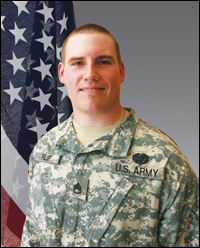
SSG Zackary Filip
ehash He is married and has three sons: Grayson, 6, Gabriel, 3, and Gavin, 3 months.
ehash FORT HOOD, Texas — Staff Sgt. Zackary Filip of the 1st Cavalry Division shoved a tourniquet into the right shoulder pocket of his Army Combat Uniform and made sure all his medics had fully equipped medical packs.
ehash For thousands of other Fort Hood soldiers, June 10 was a day to relax by Belton Lake. The smell of grilled burgers and hot dogs floated in the breeze. Local garage bands finished up their sound checks for the coming outdoor performance.
ehash For Filip, it was just another day to be ready. Seven months earlier, on Nov. 5, he walked up to the outside of Fort Hood’s Soldier Readiness Processing Center and found himself in the middle of the worst-ever mass killing on a U.S. military post.
ehash A gunman, alleged to be Maj. Nidal Hasan, had ended a shooting rampage inside the center and begun targeting soldiers outside.
ehash Filip watched police Sgt. Kimberly Munley and the gunman shoot their pistols at each other until both went down. “At first I thought it was fake, maybe some kind of training I didn’t know about,” Filip said.
ehash Then he smelled Munley’s blood and knew it was real. One of the gunman’s bullets had passed through Munley’s left leg and penetrated her right leg. Filip dragged Munley to the side of a building for cover since he didn’t know if there were other shooters.
ehash Filip was wearing jeans and a T-shirt and had no bandages, no medical supplies to treat gunshot wounds. He pulled off his rigger belt and cinched it around Munley’s right leg as tight as he could for a tourniquet.
ehash Filip went into “medic mode,” working with others to treat 55 other victims shot that day.
ehash “There are hurt soldiers; [you] go to work and try to help as many as you can,” Filip said.
ehash Twelve soldiers and one civilian died of their wounds. Munley and others might have died if Filip hadn’t been on the scene.
ehash Soldiers who have served with Filip say he has a reputation of “being at the wrong place at the right time ... to do some amazing things,” said Staff Sgt. Josiah Coderellis, who served alongside Filip in several gunfights in Afghanistan’s Nuristan province from June 2008 to June 2009.
ehash Filip’s unique character compelled his fellow soldiers to nominate him for the 2010 Army Times Soldier of the Year and convinced Army Times to select him as the winner.
ehash Coderellis said he has seen Filip save lives on several occasions, but the night of Dec. 24, 2008, stands out in his mind. Their platoon was attacked as they were on their way back to Combat Outpost Lowell from a patrol.
ehash He recalled walking on a narrow mountain path when gunfire erupted from the heights.
ehash “We were in a really bad spot to be attacked because we were on the road with mountains on both sides,” he said.
ehash Afghan army soldiers accompanying the American platoon began getting shot. The patrol was spread out, so Filip and Coderellis had to move under enemy fire to get to the wounded, Coderellis said.
ehash The two sprinted “like 500 meters down this road ... and I remember running and hearing a lot of gunfire,” he said.
ehash They spent the next three hours running under gunfire, treating four wounded Afghans in different locations. One had been shot through the shoulder and neck, another was shot through the knee and the third had been hurt from the concussion of an explosion.
ehash At one point, “the Apaches had gone black on ammo, and I’m like, ‘This is not good,’ we were still getting shot at,” Coderellis said.
ehash Another Afghan soldier rolled out into the road. He’d been shot through the left side of the chest, Coderellis said.
ehash Filip treated the wound, and he and Coderellis got him into an Afghan truck and away to safety.
ehash Filip always showed “a lot of genuine concern” for any soldier who needed help, American or Afghan, Coderellis said.
ehash “He didn’t hesitate and say, ‘Who got shot?’ There wasn’t any, ‘Well these aren’t my guys, so I’m not going to go,’ “ Coderellis said.“And there were people that were like, ‘They are not our soldiers.’”
ehash Filip and Coderellis were awarded the Army Commendation Medal with V device for valor for their actions that night.
ehash Filip, 25, now serves as the platoon sergeant for 4th Squadron, 9th Cavalry Regiment’s medical platoon.
ehash “To be selected for that as a staff sergeant is huge,” Capt. Nathan Jennings, commander of Filip’s unit Headquarters and Headquarters Troop, told Army Times at the June 10 postwide soldier recreation day.“He’s the complete package.”
ehash In coordinating the medical support for the event, Filip ordered enough medical supplies to treat up to 10,000 soldiers for everything from dehydration to trauma wounds.
ehash His orders to his medics were simple: “You will have a tourniquet in your pocket and you will have a fully -stocked aid bag,” he said.
ehash Filip, whose hometown is Denton, Texas, said he never planned on making the Army a career, but his experiences in Afghanistan and in the Fort Hood shooting changed him.
ehash “I have been very blessed; a lot of things could have gone other ways,” he said. “When I first enlisted it was me, me, me — get out of this town, get a bonus, get some college money. ... Why am I here now? I like training and leading soldiers. I love what I do. I think I have the most important job in the Army. What is more important than saving lives?”
2010 Soldier of the Year
honorable

SPC Roger Bahrman
Bahrman is originally from Skandia, Mich.
Bahrman was involved in handling the remains of 105 casualties, including 14 children, while deployed to Afghanistan from December 2008 to December 2009. The cook was assigned to 3rd Brigade Combat Team’s mortuary affairs team during that year because his cooking skills weren’t needed at Forward Operating Base Shank.
His superiors say Bahrman often volunteered to handle remains of children so that fellow soldiers with children would not have to suffer the emotional trauma.
“I always thought to myself that it’s better me doing the job than one of my fellow soldiers who wouldn’t be able to take on the burden of sending soldiers or even local nationals back to their families,” Bahrman told Army Times.
“He stared the absolute worst part of war in the face countless times,” said Maj. Andrew DeKever, his officer in charge during the deployment. “Whenever we received word that someone had been killed and was being brought to us for processing, I would always find Specialist Bahrman at the MA tent, volunteering his services even when he wasn’t scheduled to be on shift.”
Not only did Bahrman master “the technical aspects of being a 29M, he rose to the occasion as a leader in the eyes of the other members of his team, in addition to sacrificing himself routinely to protect other members of the team from the emotional scars of this field,” DeKever said.