
2007 Coastguardsman of the Year
honorable
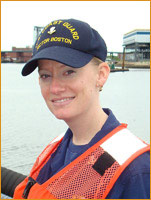
Marine Science Technician 2nd Jessica Watts
The marine environment off the Massachusetts coast could have no better champion than Marine Science Technician 2nd Class Jessica Watts, her superiors and shipmates say.
"She has earned a reputation for reliability and established herself as one of the best pollution investigators and facility inspectors in the unit," one officer wrote.
She "acted decisively" when responding to a 20,000-gallon diesel oil spill, another officer wrote, and, after a second, 18,000-gallon spill, Watts "directed the immediate response and ensured the recovery of more than 70 percent of the oil, protecting the environment and salvaging the Coast Guard's vital relationship with the community."
She also prevented at least one other oil spill, having identified substandard equipment at an oil facility near Boston and making sure it was replaced to ease the environmental risk.
"She is extremely hardworking, intelligent and innovative and always takes on more than her share to make our unit the best it can be," an officer wrote.
2007 Coastguardsman of the Year
honorable
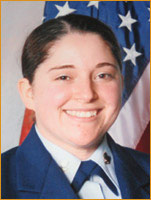
Yeoman 2nd Class Jacqueline Rocklage
When a senior chief yeoman unexpectedly left her unit, Yeoman 2nd Class Jacqueline Rocklage stepped up and took over a range of tasks normally performed by more experienced Coast Guardsmen, her shipmates say.
And she did it with a good attitude while setting a good example, wrote one teammate. "Her work ethic far exceeds her peers and (she) is always looked upon as a mentor and an outstanding future leader," the shipmate wrote. "She remains positive and upbeat even when she under incredible pressure from within this office as well as her outside responsibilities and collateral duties."
Her colleagues praised her work as a morale builder; Rocklage has coordinated spaghetti lunches, Seattle Mariners game outings, bake sales and more, they said.
"She oozes the core values," one officer wrote. "Anyone who deals with her, even ... briefly, can see she is a model Coastie."
2007 Coastguardsman of the Year
winner
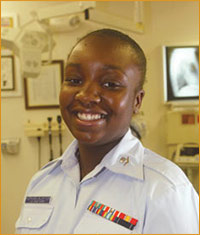
Health Services Technician Anjelica Hopkins-Slayton
Hails from a Navy family: mother and stepfather are both Navy medical personnel. Graduated from high school in Naples, Italy.
MIAMI, Florida - Health Services Technician 3rd Class Anjelica Hopkins-Slayton, 20, was one half of the two-person medical team aboard the cutter Dallas, on patrol in the Caribbean last September, when it stopped a boat crammed with more than 80 Cuban migrants.
The migrants were brought aboard, and suddenly her ship was full of strangers, some of whom needed help.
"It was an environment where you know you have to take control because it's either going to go on the straight and narrow, or go crazy, and I definitely didn't want it to go crazy," Hopkins-Slayton said.
So she took control. She has made a habit of that.
Working with shipmates, and even enlisting the help of a Cuban doctor who spoke enough English to help translate, Hopkins-Slayton "exhibited a command presence far greater than that expected of a 19-year-old HS3," wrote her department head, Chief Warrant Officer 2 Douglas Apperson.
She quickly arranged medical care for the migrants, some of whom were badly dehydrated. When a man complained of severe pain, Hopkins-Slayton started intravenous therapy and gave him morphine - "Something I would never have fathomed doing as a third class," she said. "It was extremely exciting.
"I like being in any situation where there's high drama," she said. "I love that. I like being challenged. It's where you find out what you actually know."
Hopkins-Slayton spent an eventful 18 months aboard the Dallas, during which she looked after her shipmates and contributed to a range of public-service projects, including a big repair job on a school and orphanage in the Dominican Republic.
"Her work ethic was tremendous," said the Dallas' skipper, Capt. Eric Brown. Hopkins-Slayton was "admired and respected by all."
Brown and other superiors eventually made her Coast Guard Atlantic Area's enlisted person of the year. When she went to Washington, D.C., to accept that award, she was challenged again.
Hopkins-Slayton had to give a toast along with other military honorees in front of a galaxy of flag officers' stars, Coast Guard Atlantic Area Command Master Chief William James said. But the script for the toast got lost, Hopkins-Slayton said, and she was able to get it from the hotel fax machine mere moments before she was scheduled to speak. Meanwhile, senior officers, including captains and commanders, were standing up.
"And they all blew their toasts," James said. "They forgot the words. She was the only one who got it right. She personalized it a little bit, made a hit in front of the crowd. This is a very together young lady," he said.
James said he hopes Hopkins-Slayton stays in the Coast Guard and becomes an officer, but she laughed and demurred when asked about her future plans. She serves now in the medical center at Coast Guard Air Station Miami and has a year left in uniform, but she said her future "is all up in the air right now."
Even with the official attention that her accolades have attracted, Hopkins-Slayton said she doesn't feel any pressure as she considers how to move forward.
"I'm doing something somewhat right, so I'm going to continue to do that," she said. "Whenever you're put into a position where you're honored, you should definitely take that time to let other people know that they can do the exact same thing that you're doing, that you're no different. Having a good attitude has gotten me where I am. You've got to remember that, at the end of the day, just relax, you know?"
2007 Airman of the Year
notable
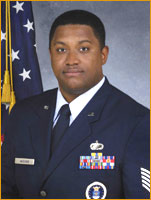
Tech. Sgt. Antonio McCloud
Tech. Sgt. Antonio McCloud, a personnel specialist, provides administrative support for the recruiters in his squadron. He has breathed new life into programs, including the sponsor, command drug testing, duty status and temporary duty programs, and established a database to track decorations for members of previous units. An ordained minister, he has donated hundreds of hours to his church, youth groups and homeless shelters. He mentors youth in the local community and junior troops in his squadron.
2007 Airman of the Year
notable
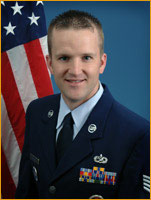
Staff Sgt. Skye Edmister
Teaching is a passion for Staff Sgt. Skye Edmister, who helps future avionics maintainers hone their skills. Winner of the John A. Levitow and Leadership awards at the Airman Leadership School, Edmister also volunteered for the base honor guard, participating in 25 military funerals, and was selected as lead trainer for 35 airmen. He was named airman of the year at the squadron and group level. He is also on track to graduate this fall with a bachelor's degree from Embry-Riddle Aeronautical University.
2007 Airman of the Year
honorable
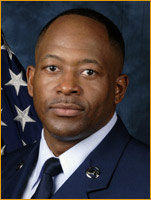
Senior Master Sergeant Tony Levine
Senior Master Sgt. Tony Levine is an on-base mentor and an off-base community leader. When not on duty, Levine walks drug-infested communities in Charleston with the Citizens' Patrol Against Drugs, a grass-roots activist group determined to reduce drug sales. He has also helped increase funding to improve low-income neighborhoods.
Levine mentors junior airmen and noncommissioned officers at Charleston Air Force Base. During a deployment to Qatar, his intelligence work assisted in the completion of nearly 800 combat missions and about 3,000 cargo deliveries.
Levine was also last year's Air Reserve Component Intelligence Senior Noncommissioned Officer of the Year.
2007 Airman of the Year
honorable
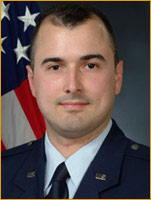
Capt. Peter Gruters
Capt. Peter Gruters, an intelligence officer overseeing bomber and tanker crews, has deployed four times to Iraq or Afghanistan over the past three years. His most prominent work was in support of Operation Mountain Lion, a spring 2006 sweep through the high-altitude Gardez and Khost regions of Afghanistan to clear out militants. Gruters aided more than 70 weapons drops - many of them satellite-guided bombs - in the mountainous provinces. He also re-engineered bomber and tanker shops to streamline processes and cut manpower.
At Robins, Gruters works intel for one of the Air Force's most specialized KC-135 cargo and refueling jet units. He also prepared a presentation of Afghan political history for aircraft maintenance and medical personnel.
Outside his military duties, Gruters has taken a 12-year-old Georgia boy under his wing through the Big Brothers Big Sisters mentorship program - and was recognized by the national organization with a "Heroes in Our Midst" award - all while continuing his deployment rotations.
2007 Airman of the Year
winner
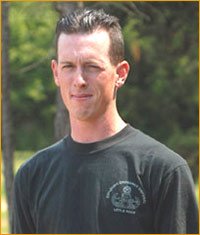
Staff Sergeant Matthew Patnaude
Born in Palmyra, New York. Enlisted shortly before the Sept. 11, 2001 terrorist attacks. Mentors Boy Scouts in Arkansas.
LITTLE ROCK AIR FORCE BASE, Ark. - It's sticky hot in the Arkansas wilderness. Staff Sgt. Matthew Patnaude is crouched in a man-made clearing, a wide circle of sun-bleached gravel. His fingers work blasting caps, detonation cord and a fat brick of C4 plastic explosives that, if ignited, would blow him to vapors.
Instead, the training exercise ends minutes later with a controlled detonation. It's stunning for the uninitiated. The blast spits rock high above the tree line and yields a lingering cloud of black smoke.
This is pedestrian to Patnaude. At 24, he wears twin Purple Heart medals. Both were earned in the course of his dirty and dangerous job: disarming roadside bombs, the No. 1 killer of American troops in Iraq.
Patnaude's work with explosive ordnance disposal units has put his profile on the rise. His supervisors say he's meticulous but bold, exactly the demeanor needed to clear bombs day after day in the desert. And Patnaude isn't shy, they say, about revealing his scars and his wisdom to junior airmen who look to him for tips and guidance.
Snipers, explosive booby traps and sandstorms defined Patnaude's tours in Iraq. Stationed in Kirkuk, he completed a dizzying 105 missions in his last five-month deployment. In 2006, he neutralized 45 makeshift bombs, more than 40,000 pieces of explosive ordnance and nine insurgent weapons caches.
The bombs came in all flavors. Some were fitted with fuse wire strung to a nearby hideout. Others were rigged to remote devices, often cordless phones, or circuits draped across the road.
"Over there, anything could be a bomb," Patnaude said. "That little piece of trash, that mound of dirt, could be covering something explosive."
Some threats seemingly came from nowhere. In July 2005, as he and his team chief were responding to a call during his first Iraq tour, the team chief stepped on a bomb-rigged sewing machine pedal hidden under the powder-fine sand. Both airmen received a Purple Heart: the chief for nonfatal blast injuries, Patnaude for a ruptured eardrum.
More than a year passed before Patnaude earned his second. The December mission near Kirkuk began as most did. From the truck, Patnaude activated his one-armed sidekick, a Remotec robot controlled remotely with joysticks, dials and a squiggly view screen. The camera-fitted robots check out suspected bombs. Disarming them is still a hands-on job.
Patnaude crumbled shortly after stepping off his truck's back ramp as a sniper's 7.62mm bullet entered his left leg, nicking his intestines and tailbone on the way out.
His team radioed for airlift. Not until this sandstorm clears, the base radioed back.
The roughly 30 soldiers defending the team's position were startled when an Army Special Forces patrol sped into view and slid Patnaude, half-paralyzed on a stretcher, into the back of their Humvee. The SF soldiers treated him in the field, plugging his exit wound with a tampon, then sped to a nearby house in pursuit of the sniper. During the raid, which did not root out the gunman, Patnaude lay prone by the hatch gunner's legs.
Patnaude is now patched up, a colostomy bag and spinal surgeries behind him. While recovering, he helped convince commanders that snipers were singling out EOD airmen because of their distinct dress. Across Iraq, EOD team chiefs were immediately cleared to put their airmen in Army uniforms, says Master Sgt. Amanda Alexander, an EOD veteran stationed at Little Rock.
Back in Arkansas, Patnaude is a humble standout who leads Boy Scouts of America treks into the surrounding woods in his off time.
His supervisors tell him he can leave the military if he wants. But Patnaude, restless in Little Rock, still hears the desert calling his name.
"He just won't quit," Alexander says. "He's putting his life on the line, but for Matt, it's really about keeping everyone else safe. That's his reward."
2007 Sailor of the Year
notable
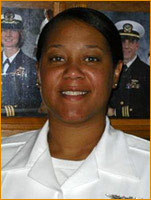
IT1 Anitra Hendricks
Naval Computer and Telecommunications Station Far East, Yokosuka, Japan Information Systems Technician 1st Class Anitra Hendricks, the information systems security manager for Naval Computer and Telecommunications Station Far East, Yokosuka, Japan, is "a team player in every sense of the word," wrote one officer, praising a "technical acumen" that makes her "the go-to first class petty officer at the command." Shipmates also praised her integrity: "She stood up for what was right even though it wasn't the most popular decision," one shipmate wrote.
2007 Sailor of the Year
notable
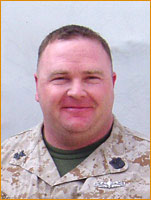
HM1 Daniel Rodgers
1st Battalion (Light Infantry), 1st Brigade, 3rd Iraqi Army Division, Tal Afar, Iraq Hospital Corpsman 1st Class Daniel Rodgers saved the life of an elderly boater while serving aboard the dock landing ship Trenton. Now a medical adviser to an Iraqi army battalion, he saved the lives of at least 20 Iraqi soldiers before a medevac helicopter could arrive, and when he noticed a suspicious wound on an Iraqi insurgent, he searched the man's garage and found explosives, ammunition and tools for making improvised explosive devices. An Army officer stationed with Rodgers wrote that he "has nerves of steel and is not easily rattled."